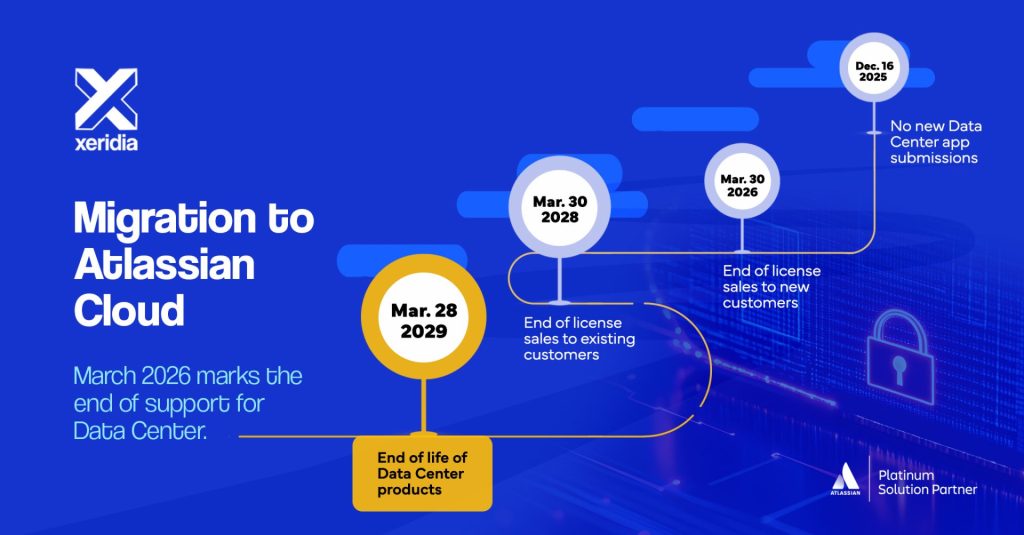
Atlassian has officially announced that it will end support for its Data Centre products in March 2029. This milestone will force many organisations to migrate their instances and data to Atlassian Cloud or other managed environments. This announcement means that migrating data to the cloud is now a key item on many companies’ agendas.
Migrating correctly is critical: it affects business continuity and the experience of teams using Atlassian (Jira, Confluence, Bitbucket…). But there is no single way to do it right. Each migration depends on the size of the instance, existing integrations and security requirements. That is why migration is not an IT project; it is a precision operation and an evolution of an organisation’s working system.
Atlassian is bolstering this move with an acceleration and support programme for the migration process (Ascend) and a dedicated FastShift team. But the most important thing is not the destination: the cloud. Nor is it simply ensuring that the cloud environment is technically sound. As we have already seen, a migration is not merely a transfer of data; it is a key process for technological evolution. Something that affects the very heart of the company: its processes, permissions, workflows, integrations, and its knowledge.
Migrating whilst maintaining the level of customisation
In practice, the biggest challenge is not just importing and exporting data. It lies in everything that goes with it: the permissions structure, integrations with external systems, custom workflows, plugins which, in many cases, have no direct equivalent in the cloud, the years of historical data that must be cleaned and classified before migrating, etc.
- Add-ons and extensions: finding equivalents in the cloud or developing and extending plugin functionalities such as advanced reporting, backups, automations...
- Integrations: to maintain the connection of data flows between the company’s tools: repositories, pipelines...
- Data governance: roles, permissions, traceability to ensure security and compliance processes.
- Data performance: historical data requires classification and cleaning to ensure an agile cloud instance from the outset.
Organisations seek the perfect fit between the Atlassian ecosystem and their infrastructures, ensuring their customisation, maintainability and scalability.
Examples of migrations we have carried out at Xeridia
FINANCIAL SECTOR
Consolidation of 8 ticketing tools into a single platform
A leading banking institution consolidated all its ticketing channels and tools—previously scattered and lacking real integration—onto a single Atlassian Cloud platform: Jira, EasyVista, ServiceNow, Maximo, Lotus Notes, Manage Engine, Mantis and Jira - Confluence Server.
The result was the standardisation of processes and a unified management model, with reduced response times, operational simplification and end-to-end traceability. This consolidation provided a 360° view of the service and enhanced the experience for both the business and IT.
Challenge: a fragmented ecosystem comprising 8 tools with no integration.
Tools: Jira and Confluence Server, ServiceNow, EasyVista, Maximo, Lotus Notes, Manage Engine, Mantis...
Result: a unified platform with end-to-end traceability.
TECHNOLOGICAL SECTOR
Corporate split: separation into two entities with operational continuity
We supported a technology company through a corporate split process that required a partial migration to the cloud from two on-premises instances of Jira and Confluence. The project required a redesign of the governance and access model: reassigning users, reviewing permissions and visibility settings, redefining owners, and adjusting the structure to ensure continuity, security and separation between the new entities.
Challenge: to split into two distinct entities whilst managing the division of data, permissions and access.
Tools: Jira and Confluence from on-premise to the cloud.
Result: two independent entities with governance and operational continuity.
EDUCATION SECTOR
Consolidation of four heterogeneous Server instances into a single Cloud environment
An organisation in the education sector consolidated four highly customised Server instances—featuring bespoke developments, heterogeneous configurations and different databases—into a single Jira-Confluence Cloud environment.
The challenge involved the coexistence of different IdPs, the reorganisation of schemas and functionalities, and the standardisation of configurations. Furthermore, integrations with databases were rebuilt using cloud apps not used on Server, reworking requests and layouts to keep critical connections and flows operational.
Challenge: 4 instances with different configurations, databases and IdPs.
Tools: Jira Server + Confluence Server + databases external to the cloud.
Result: a unified environment with rebuilt integrations and active critical workflows.
RETAIL SECTOR
Migration from an in-house tool to Jira Cloud with comprehensive asset management
A retail company migrated from a bespoke in-house tool to Jira Cloud, including asset management.
The focus was on ensuring a seamless transition: the strategy was designed to retain the asset history with the same level of detail and traceability as in their bespoke solution, guaranteeing continuity in auditing, monitoring and data utilisation.
Challenge: preserving asset history and traceability from an ad hoc tool.
Tools: bespoke tool to Jira Cloud + Assets.
Result: asset management in Jira Cloud with full continuity in auditing and data.
INTERNATIONAL FINANCIAL SECTOR
Consolidating a fragmented system: from multiple tools and Excel to Jira Cloud
At an international bank with a fragmented ecosystem: ranging from severely outdated server instances to Excel-based processes and bespoke tool, all operations were consolidated into a single Jira Cloud instance.
Only one of the on-premise instances allowed for a standard migration; the rest required rebuilding the functionality from scratch in the Cloud and performing data imports via bespoke developments, whilst preserving critical information such as historical data, comments, attachments and full traceability.
Challenge: obsolete instances, Excel and ad hoc tools with no standard migration possible.
Tools: multiple Server instances + Excel + ad hoc tools to Jira Cloud.
Result: consolidated system with complete history, attachments and traceability.
LEGAL SECTOR
Resolving technical debt in Jira: migration to the Cloud with a complete redesign of the configuration
At a firm in the legal sector, an in-depth analysis of the existing on-premise instance was carried out. During the review, deviations from the recommended configuration and best practices published by Atlassian were identified, which made using Jira complex and cumbersome for the end user.
After analysing the current configuration, the client’s needs and planned developments, the redesign of Jira in a Cloud environment was undertaken. The result was a more intuitive and user-friendly tool, aligned with best practices and consistent with the client’s working patterns and policies.
Challenge: an instance with serious deviations that hindered day-to-day use.
Tools: Jira on-premise to Jira Cloud, redesigned from scratch.
Result: Jira Cloud with no technical debt, standardised and aligned configuration with Atlassian guidelines.
What does it take for Atlassian Cloud migration project to succeed?
Successfully executed data migration should be seen as an opportunity to modernise systems, redesign processes and optimise the way the company operates. Migrations to Atlassian Cloud require:
- Strategic vision: an understanding of the business and its objectives.
- Cross-functional expertise: mastery of complementary technologies: AI, bespoke software development...
- Automation and DevOps: it is increasingly common for configurations and processes to rely on automation to ensure that the operational flow with other corporate systems and tools is not disrupted.
- Certified expertise: working with official partners who hold certifications and have a proven track record in complex projects.
Often, a cloud platform does not replicate legacy on-premise configurations 100%. At Xeridia, as a Platinum Solution Partner, we help our clients migrate to the cloud with certified teams and nearly 20 years of experience in Atlassian. And as data migration is rarely limited to a single process, we have specialists in other areas: AI, DevOps and IT service management.
Do you have a migration project? Tell us where you are starting from and we will help you with your Atlassian migration.