In recent years, Artificial Intelligence has gone from being a specialised technology, used only in research environments or in very specific applications, to becoming an everyday tool present in a multitude of business processes and software applications. Models capable of recognising images, translating texts or generating natural language have represented a major advance in the way we interact with technology.
However, most of these systems share an important limitation: they are passive models. They receive input, process it and return output, but they do not make decisions on their own or interact autonomously with their environment. To respond to more complex problems, where it is not enough to generate a response, but it is necessary to reason, decide and act, the concept of the Artificial Intelligence agent has emerged.
What is an Artificial Intelligence agent?
An AI agent is a software component that interprets signals from the environment, decides on the steps to take and executes actions autonomously with the aim of achieving a goal. Unlike a traditional AI model, which is limited to responding to a query, an agent is capable of chaining decisions, using external tools and adapting its behaviour according to the context.
For example, a language model can analyse a set of tasks and generate a summary or prioritisation based on textual criteria. An AI agent, on the other hand, can use that analysis to automatically update the status of tasks in the management tool, assign them to the appropriate managers, and notify them of the changes made. In this way, the model's reasoning is translated into concrete actions on real systems.
In this context, agents enable a shift from solutions based solely on analysis or recommendation to systems capable of actively intervening in processes, reducing the need for human supervision and increasing operational efficiency.
How does an Artificial Intelligence agent work?
The operation of an AI agent is based on a different approach to traditional software development. Instead of explicitly defining all the decisions that the system can make, an objective, a set of capabilities and an operating environment are established. Based on these elements, the agent analyses the situation at any given moment and autonomously decides on the most appropriate action to take in order to move towards that objective.
This approach allows for the construction of more flexible and adaptive systems, capable of operating in dynamic environments and managing tasks whose complexity makes it unfeasible to model them using fixed rules or rigid execution flows.
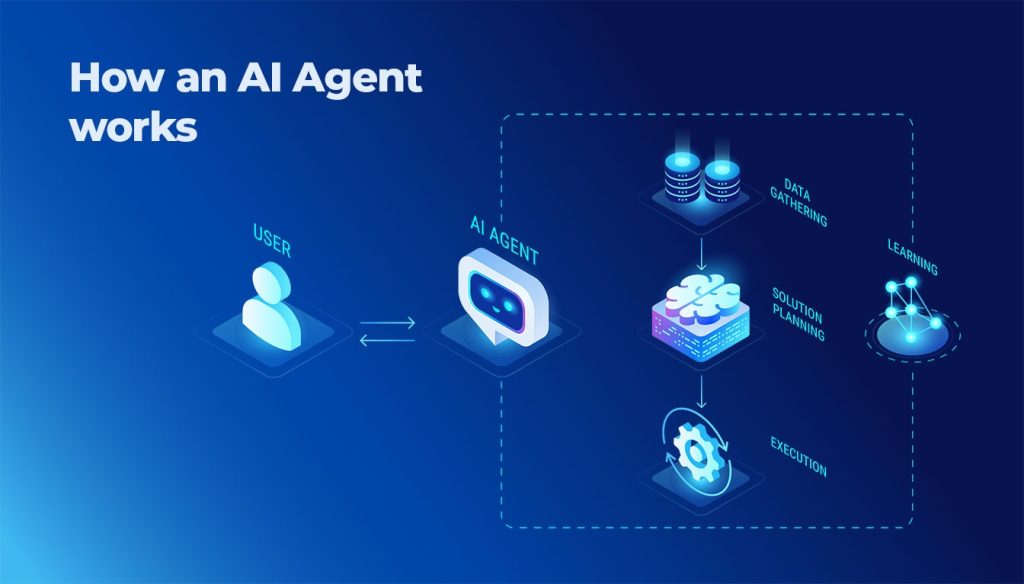
Although there are multiple implementations and architectures, most AI agents share a common operating cycle that can be summarised in four main stages:
- Perception: the agent receives information from its environment. This information can come from user input, databases, sensors, external APIs, or corporate systems.
- Reasoning: based on the information received and its internal state, the agent analyses the situation and decides on the most appropriate action.
- Action: the agent executes one or more actions, such as calling an API, generating a document, sending an email, or updating an external system.
- Evaluation: after the action, the agent evaluates the result and updates its internal state, which will influence future decisions.
This cycle is repeated continuously while the agent is active, allowing it to adapt to changes in the environment and new conditions.
Main components of an AI agent
In order to carry out this autonomous behaviour, an Artificial Intelligence agent is usually composed of several key elements:
- Reasoning model: typically, a language model or inference system that allows it to interpret information and make decisions.
- Memory or state: stores relevant information about the context, past interactions, or intermediate results, preventing the agent from acting in isolation at each step.
- Tools and capabilities: a set of actions (tools) that the agent can execute, such as consulting a database, accessing a management system or interacting with external services.
- Control logic: defines how and when the tools are used, as well as the criteria for continuing, stopping or modifying the agent's behaviour.
The correct combination of these components is essential to ensure that the agent acts consistently and efficiently.
Applications of Artificial Intelligence agents
AI agents are particularly useful in scenarios where it is not enough to analyse information, but where it is necessary to make decisions and act on existing systems. Their value lies in their ability to integrate reasoning and action into real workflows.
Some of the main areas in which they are used are:
- Automation of administrative tasks, such as managing emails, incidents, tickets or diaries.
- Coordination of workflows between different applications and services, reducing manual intervention.
- Analysis of information from multiple sources, with automatic generation of reports, summaries or alerts.
- Management of complex processes involving multiple steps, dependencies and systems.
Compared to traditional approaches to automation, Artificial Intelligence agents offer clear advantages:
- Greater flexibility in the face of changes in the environment or requirements.
- Ability to adapt to context and unforeseen situations.
- Reduction of the human operational burden in repetitive or low-value tasks.
- Scalability, allowing multiple processes to be managed in parallel.
These characteristics explain why AI agents are establishing themselves as a key component in the development of modern intelligent solutions, capable of going beyond analysis or recommendation to actively intervene in processes.
In this sense, AI agents represent a further step in the evolution of intelligent systems. Compared to passive models that merely generate responses, they introduce autonomy, decision-making and action capabilities in the environment, allowing more complex problems to be addressed more efficiently.
As these technologies continue to advance and integrate with real systems, agents are emerging as a fundamental tool for transforming processes, improving productivity and developing smarter, more adaptive software.
In Xeridia's Artificial Intelligence department, this approach allows us to design solutions capable of extracting real value from data and automating business processes. If you would like to know how we apply these technologies into real projects, please contact our AI team.